

by Bhashini
Signup
About KYS

KYS stands for Know Yourself.

It's a private space to understand how you actually think and decide, and to train yourself to do both better.

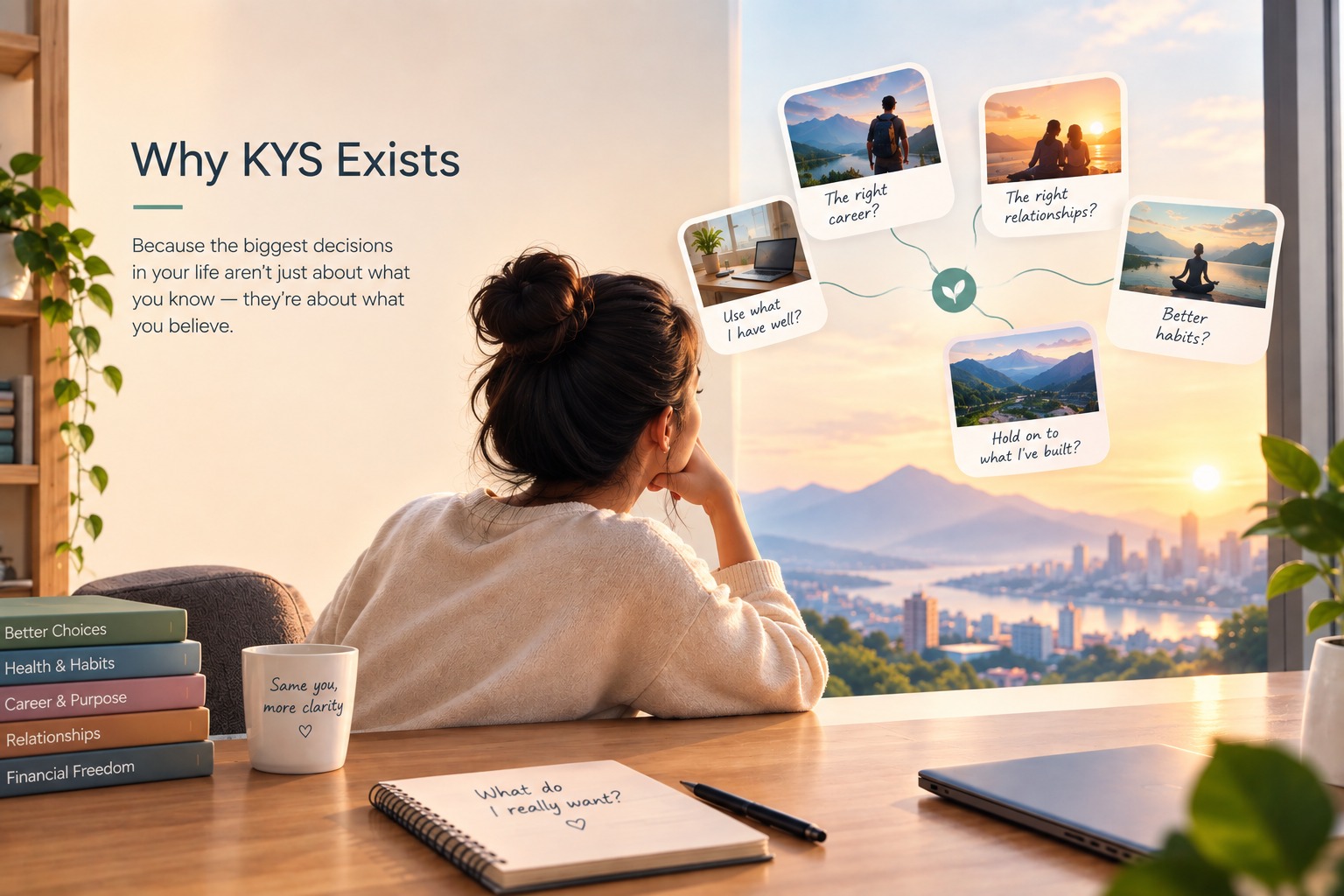
Why KYS Exists

We have more information, more advice, and more choices than any generation before us. Yet people still end up in the wrong career, the wrong relationships, and the wrong habits they never meant to keep.

It isn't because they don't know enough. It's because the thing making their decisions, their own belief system, is the one thing they almost never look at. We assume we know what we believe. Most of the time, we're only partly right.

Many of the questions people still ask themselves were built for a time of struggle: how to get more, how to get through. Many of us have moved past that point, and the harder question now is different: how do I use what I have well, and hold on to what I've built?

KYS exists to help with that question, starting with the only place it can be answered: yourself.

Built on a Model and Not Opinions

KYS is not a set of tips or motivational content. It is built on a complete model of how people and the groups they belong to think, decide, drift, and change.

  • The Fault Line Model explains the problem: how belief systems drift away from reality without anyone noticing.
  • [Book 1A title] explains the solution: what is actually within your control, and how to work on it.
  • KYS is that solution in action: tools you use in your own daily life.
[Explore the books →]

What We Stand For

Honest over comfortable. KYS is designed to show you what is actually there, not what you would like to see. The healthiest-sounding answer is never the obvious one, because comfort doesn't change anything.

Understanding and not judgment. KYS doesn't label people as good or bad. It describes what your beliefs are producing, and you decide what to do about it.

What's within your control. You can't control other people or the world around you. You can control how you read your situation, what you believe, and how you act. KYS works only on that, and it doesn't promise more.

Practice and not information. Knowing something about yourself isn't enough. Change comes from conscious, repeated practice until it becomes how you naturally think.

Independence and not dependence. KYS is built to make itself unnecessary. Once something becomes part of who you are, you don't need a tool for it anymore. You build on it.

Depth over convenience. Our exercises are full-length every time, because real change needs real effort. We know that isn't for everyone, and we have chosen depth anyway.

Private by design. What you share stays yours. Your results are shown only to you.

Our Aim

Our aim is depth, not scale. We would rather make a real and lasting difference in a focused number of lives than a small one in many. KYS is for people ready to look at themselves honestly, and that honesty shows up in how they work, how they relate to others, how they care for their health, and how they lead.

For us, success isn't how often you open KYS. It's whether your life actually changes.

Who KYS Is For

KYS is for anyone who has ever asked, "Why do I keep doing this?" and wanted a real answer.

It's for people making decisions about their own life, their family, or an organisation they lead. The starting point is always the same.

Vikram Tewari

The Person Behind KYS

Over many years of watching individuals and organisations make decisions, one pattern kept repeating. People and institutions rarely failed because they lacked intelligence, information, or good intentions. They failed because what they believed had quietly drifted away from reality, and nobody noticed until it was costly: a career that stalled, a relationship that broke, a successful company that couldn't see what was coming.

That question, why do capable people and strong institutions drift without noticing?, became The Fault Line Model. The book stops at diagnosis on purpose: it explains how the problem happens before claiming anything about how to fix it. Its companion volume turns to the solution, and KYS is that solution put into practice.

Three convictions shape everything Vikram builds:

Honesty over comfort. A model that only tells people what they want to hear can't help them. KYS is designed to show what is actually there.

Simple over sophisticated. The ideas are deep, but they have to make sense to anyone, in everyday language and everyday situations.

Impact over scale. The goal is real change in how people think and decide, in their own lives and in the organisations they lead, not the size of the user base.

"Most of what goes wrong in our lives doesn't come from believing the wrong thing. It comes from not knowing what we believe. I built KYS so that people can see it for themselves, and do something about it."
— Vikram Tewari

Where the Inspiration Comes From

Every model of how people think and decide eventually runs into a deeper question: what is "Me"?

The Fault Line Model deliberately leaves that question open. Serious thinkers have disagreed about it for thousands of years, and nothing in the model, or in KYS, depends on any single answer.

But KYS did grow out of one person's answer, and it would be less than honest not to share it.

One reality, many expressions.

In this view, each of us is an expression of one shared underlying reality, which works by the same rules everywhere. What makes each person distinct is the particular way that reality comes through them, shaped by three things together:

  • What we inherit through our genes,
  • What we absorb from the world around us
  • What we imagine and build for ourselves.

Together, these build the belief system that KYS helps you see: part hardwired, part absorbed, and part self-made.

Different but not unequal.

People clearly differ in countless ways: in circumstance, temperament, and the hand life deals them. In this view, none of that means the underlying reality treats anyone differently. The same laws of physics look completely different in an atom, a falling stone, and a galaxy, yet the laws themselves never change. In the same way, what looks like inequality is one thing expressing itself through many different lives.

Many paths, one destination.

This thinking draws on Vedantic non-dualism, a long philosophical tradition which holds that all individual selves are equal expressions of one reality. It also holds that religious, spiritual, scientific, and simply lived paths can all lead to the same understanding, and that no single path has an exclusive claim to it.

You don't need to share this view to use KYS. If you believe there is no deeper self, follow a different faith or philosophy, or would rather not take any position at all, KYS works for you exactly as fully. This is simply where the thinking behind it began, offered openly and without pressure.

Know yourself. Then decide.